
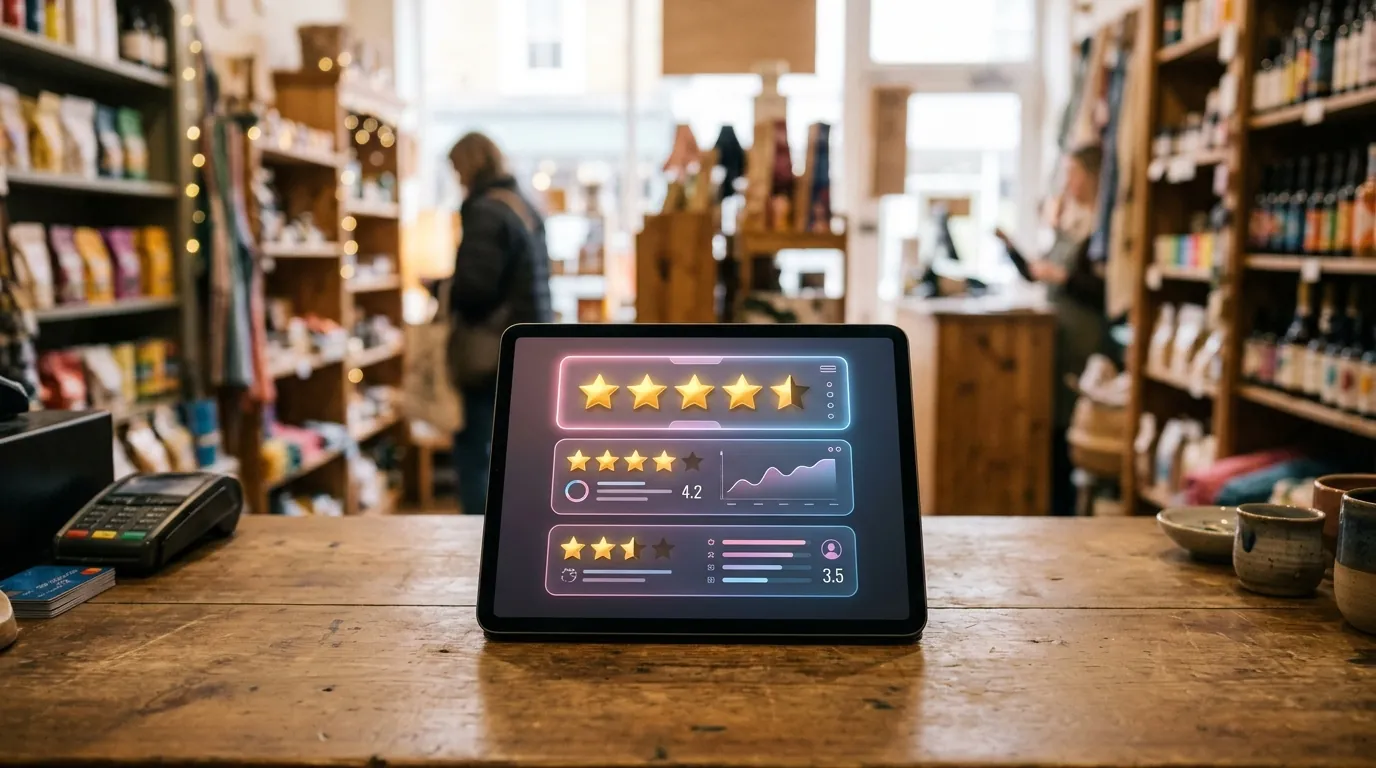
Reviews influence local SEO in two ways. They help search engines decide which businesses to show, and they help customers decide which of those businesses to choose. In 2026 that picture has become more complicated, because people now find local businesses through Google, Apple Maps, review sites and AI assistants such as ChatGPT. Each of those sources looks at reviews.
This guide explains how reviews and ratings shape local visibility today, which platforms matter for your business and how to manage reviews without it taking over your week.
Reviews affect local SEO through rankings, click-through and reputation. Google uses review count and ratings as part of its prominence factor, star ratings decide who gets the click, and reviews across the web give AI assistants the evidence they need to recommend you. Focus on Google first, then the one or two review sites that matter most in your industry.
- Google remains the most used review source, but its share fell from 83% to 71% in BrightLocal's 2026 survey as Apple Maps and AI tools grew.
- Google reviews feed local rankings directly; reviews on other trusted sites strengthen your wider reputation and AI visibility.
- Star ratings work as a filter: 31% of consumers now only use businesses rated 4.5 or higher.
- A simple review management plan covers collection, monitoring, replies and learning from feedback.
In this article
How reviews affect where you rank
Google bases local results on relevance, distance and prominence. It says prominence draws on information such as how many reviews a business has, and that more reviews and positive ratings can help local ranking. That makes Google reviews the most direct review signal for the map pack.
The content of reviews matters too. When customers describe the service they used and where they live, they add context that helps Google match your business to searches. You should never tell customers what to write, but asking for honest detail naturally produces this kind of review.
How ratings affect who gets chosen
Ratings act as a filter long before anyone reads your website. BrightLocal's 2026 survey found that 92% of consumers care about star ratings, 68% will only use a business with four or more stars and 31% insist on 4.5 or more, up from 17% a year earlier. Only 10% say they will only use a five star business, which is good news: a few honest criticisms will not hurt you, as long as your overall rating is strong.
The same survey found that the review factors people value most are that a review is positive, posted in the last month, highly rated and answered by the owner. Freshness and replies are just as important as the score itself.
The review platforms that matter
| Platform | Why it matters | Who should prioritise it |
|---|---|---|
| Feeds the map pack and Google's local results directly | Every local business | |
| Apple Maps | Default maps app on iPhone, with growing use | Businesses with lots of walk in or mobile customers |
| Trustpilot | Widely recognised, often shown in brand searches | Online sellers and service businesses that sell nationally |
| Recommendations visible to friends and local groups | Community focused businesses such as salons and cafes | |
| Industry sites | Checkatrade, Tripadvisor, Rightmove and similar sites rank well and carry trust | Trades, hospitality, property and other niche sectors |
You do not need to be everywhere. Pick Google plus the one or two platforms your customers already use, and do them well.
Get a free local SEO audit from Mark, with your quickest wins on Google Maps and in search.
Reviews and AI search
AI assistants and Google's AI Overviews build their answers from information they can find across the web. Reviews on Google and trusted third party sites are some of the strongest evidence available about whether a business is good at what it does. A business with consistent, detailed reviews across several respected platforms gives these tools far more confidence than one with a handful of old reviews in one place.
A note on review stars in search results
Some websites add review markup to their pages in the hope of showing stars in Google's organic results. Google has not shown these review stars for reviews that a local business or organisation collects and displays about itself since 2019. Showing reviews on your website is still worthwhile for visitors, but do not expect stars in the search results from your own testimonials.
The principles are the same wherever your customers are. We put them to work for businesses that want to rank in Luton, Birmingham and Sheffield.
Build a review management plan
- Collect. Ask every customer for a review at the right moment, using a direct review link, a QR code or an NFC card.
- Monitor. Turn on notifications for Google and your chosen review sites so nothing goes unanswered.
- Reply. Respond to every review with a short, personal message. BrightLocal found 80% of consumers are more likely to use a business that responds to every review.
- Learn. Look for patterns each month. Repeated praise belongs in your marketing; repeated complaints point to something to fix.
- Showcase. Display genuine reviews on your website and service pages, honestly and in context.
Google prohibits incentives for reviews, selective requests and reviews from people with a conflict of interest. UK law has also banned fake reviews and concealed incentivised reviews since 6 April 2025, and businesses that publish reviews must take steps to stop misleading reviews appearing.
For practical ideas on collecting more reviews, see five ways to improve your Google Maps reviews.
Frequently asked questions
Do reviews on Trustpilot or Facebook help my Google ranking?
Google reviews have the most direct effect on local rankings. Reviews on other trusted sites strengthen your overall reputation and can influence AI recommendations and brand searches, so they are worth collecting where your customers already use them.
What star rating do I need to win customers?
BrightLocal found that 68% of consumers will only use a business with four or more stars and 31% want 4.5 or higher, so 4.5 is a sensible target. Very few people insist on a perfect five.
Can I get review stars in Google search results from my own website?
Not for reviews a business collects about itself. Google stopped showing these self-serving review stars for local businesses and organisations in 2019.
How often should I check my reviews?
Turn on notifications so you see new reviews as they arrive, and aim to reply within a few days. A monthly review of themes and trends helps you improve your service.